Product
The Agent-Native Operating Layer,
in detail.
SynOS is the substrate your agents run on — for two transformations: run your company on agents, or make your product agent-native. Bring your own framework, harness, and models; the layer gives every agent a self-improving Context Brain, compounding skills, agent-native storage, safe build & deploy, access control, and traces — so you ship the outcome, not the plumbing underneath it. Self-hosted, multi-tenant.
Self-improving Context Brain
Streaming ingestion. Smart extraction. Entity resolution. A shared context graph of skills, entities, decisions, and traces. Self-Learning Loop: every agent trace + every human correction feeds back. The brain compounds.
Compounding Skills
Built once, then shared, versioned, and forked across the team. Installable from a skill marketplace.
Agent-Native Storage
An SoR built for how agents write. Different patterns, controls, and checks than typical DBs.
Safe Build & Deploy
Scanned sandboxes for agents and apps. Shadow → approved → autonomous, within bounded scopes.
Access Control & Audit
Per-skill, per-agent, per-team scopes. Revocable, auditable. Templates, not tickets.
Traces & Self-Learning Loop
Every skill run, every tool call captured. Cost, latency, success, hallucination signal — fed back into the brain.
See it working
Every surface, on a real company's data.
Each frame is the real product on a synthetic company (Meridian) — nothing staged but the data. The 70-second tour of all of this lives on the home page.
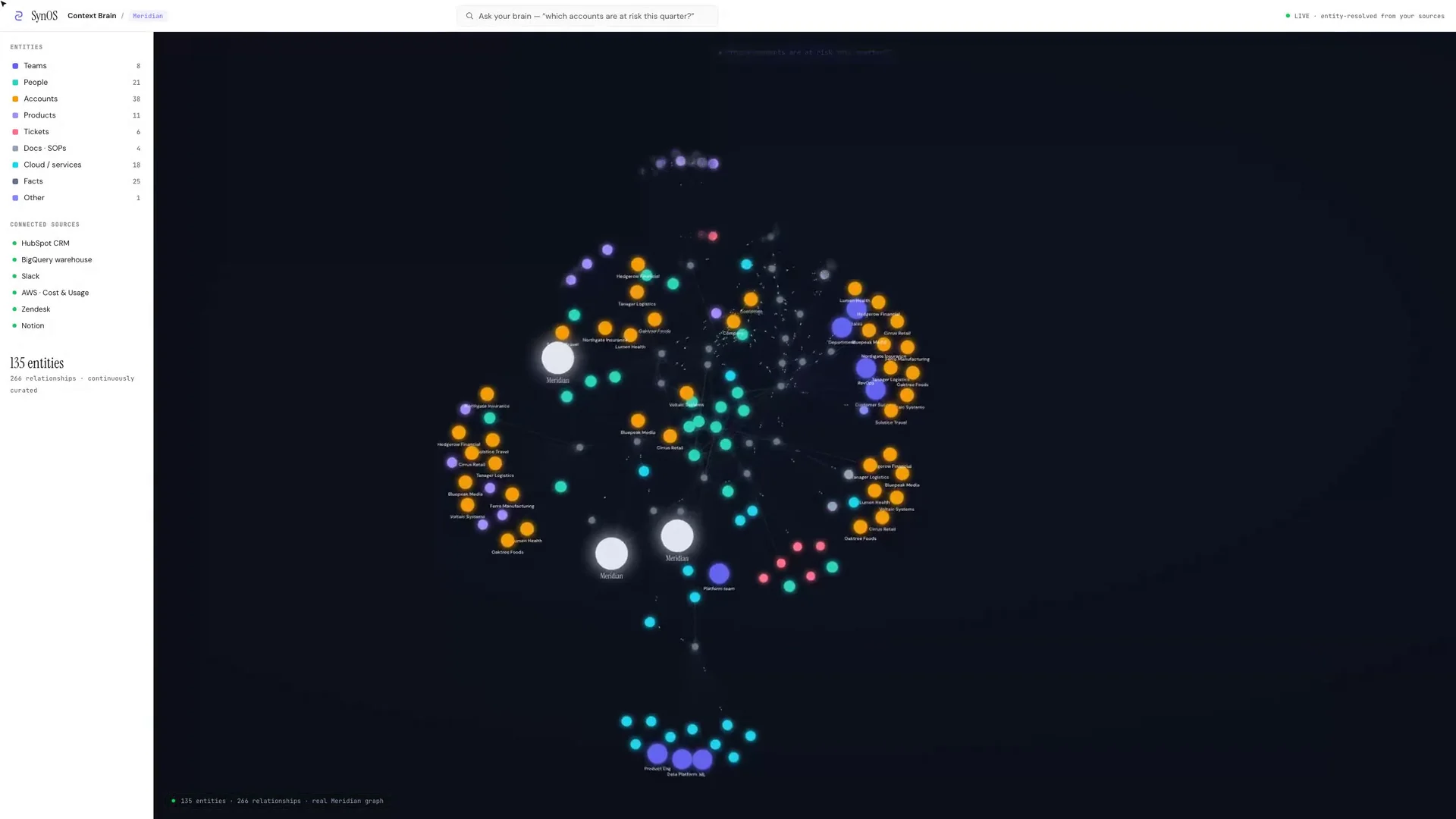
A live company brain — not static RAG
Meridian's entity-resolved graph across accounts, people, services, docs and SOPs — categorized, cross-linked, and continuously curated from every connected source.
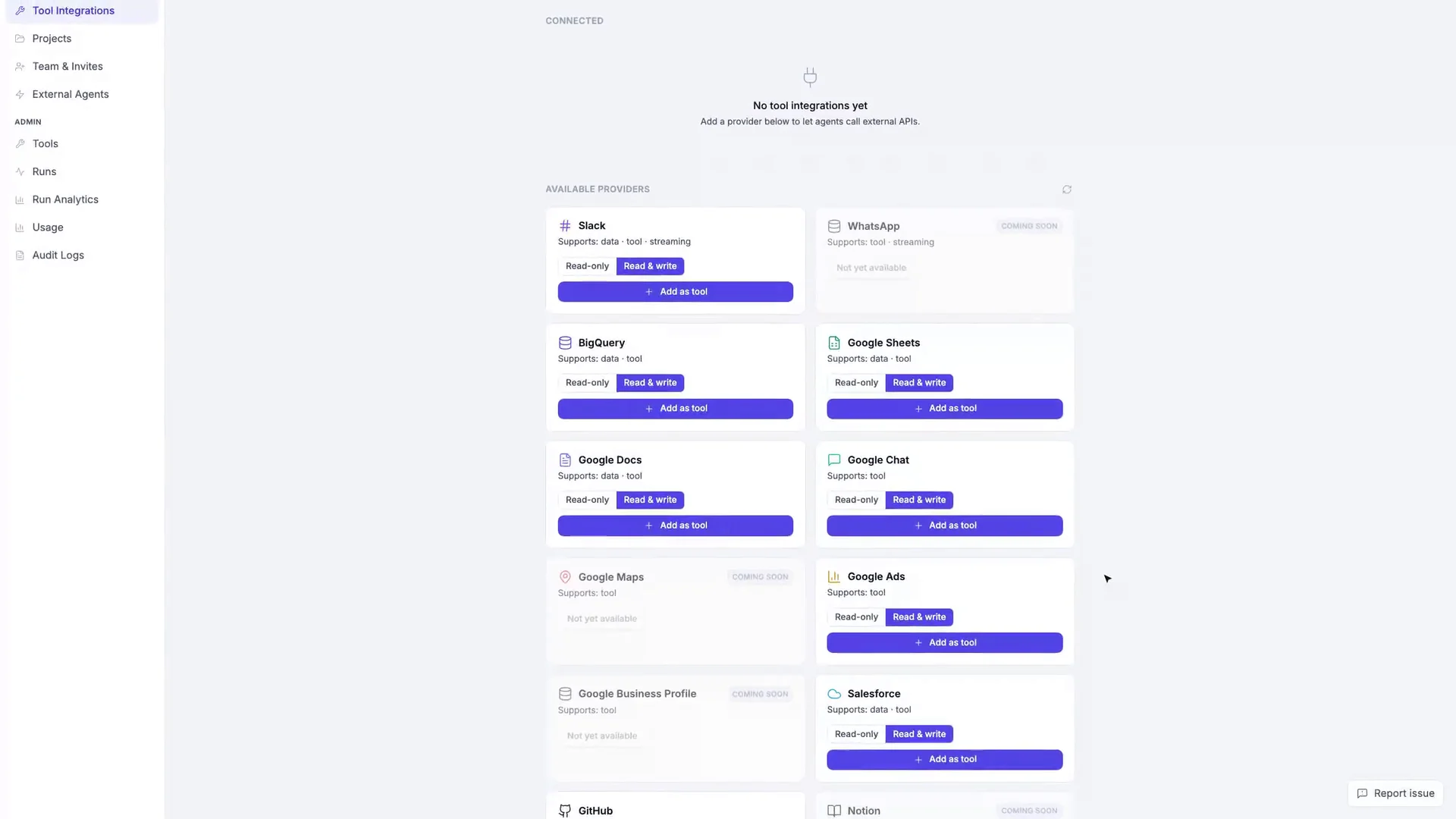
Connect every system — with permission controls
Warehouses, SaaS and internal APIs, each with read-only / read-and-write scopes before anything is added as a tool.

Documents & unstructured data become context
SOPs, notes and files are ingested, summarized and linked into the same brain — not left in a separate silo.
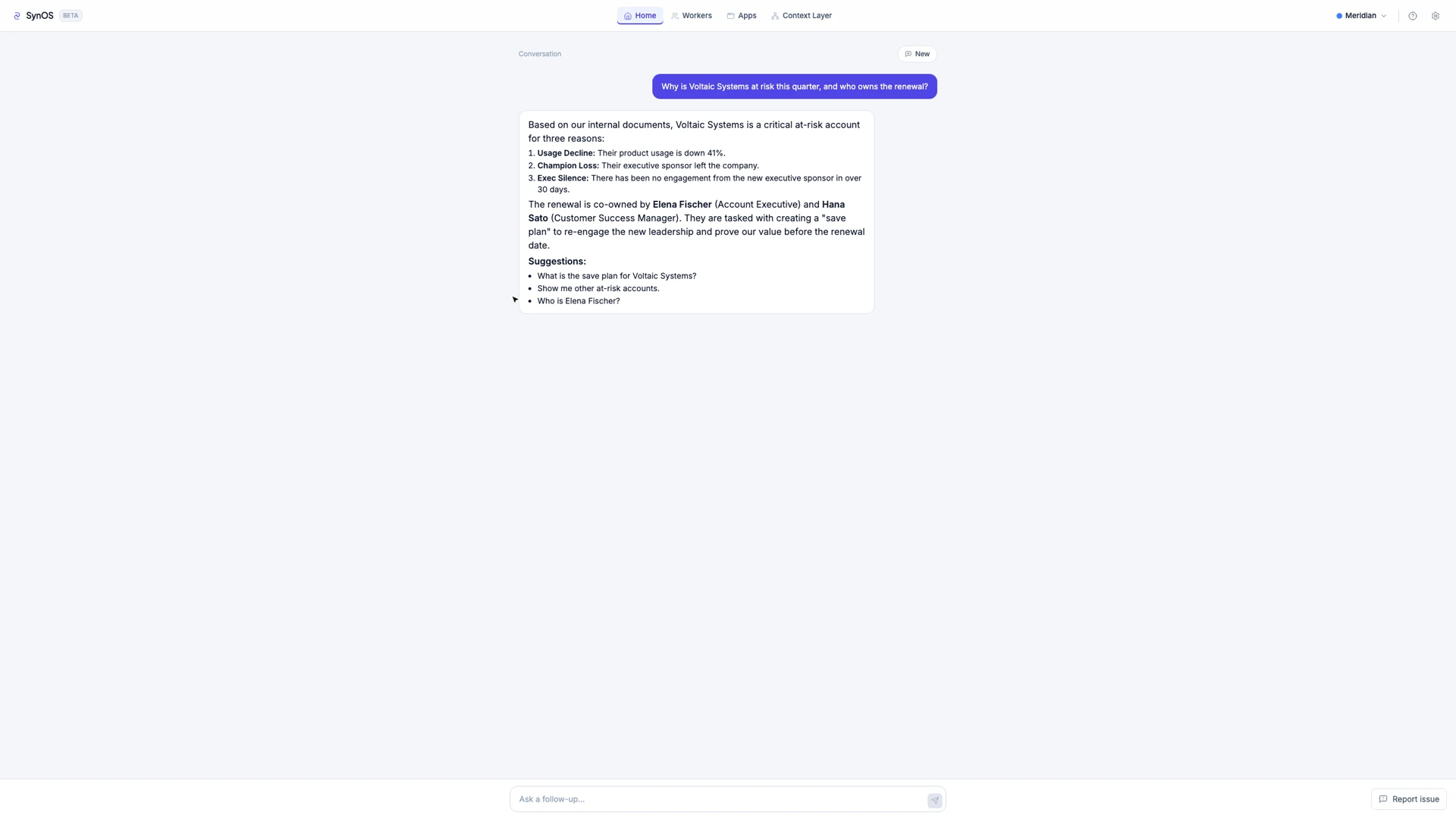
Grounded answers, cited to your systems
"Why is Voltaic Systems at risk, and who owns the renewal?" — answered from the brain with the owner, the champion loss, the −41% usage. Not a guess.
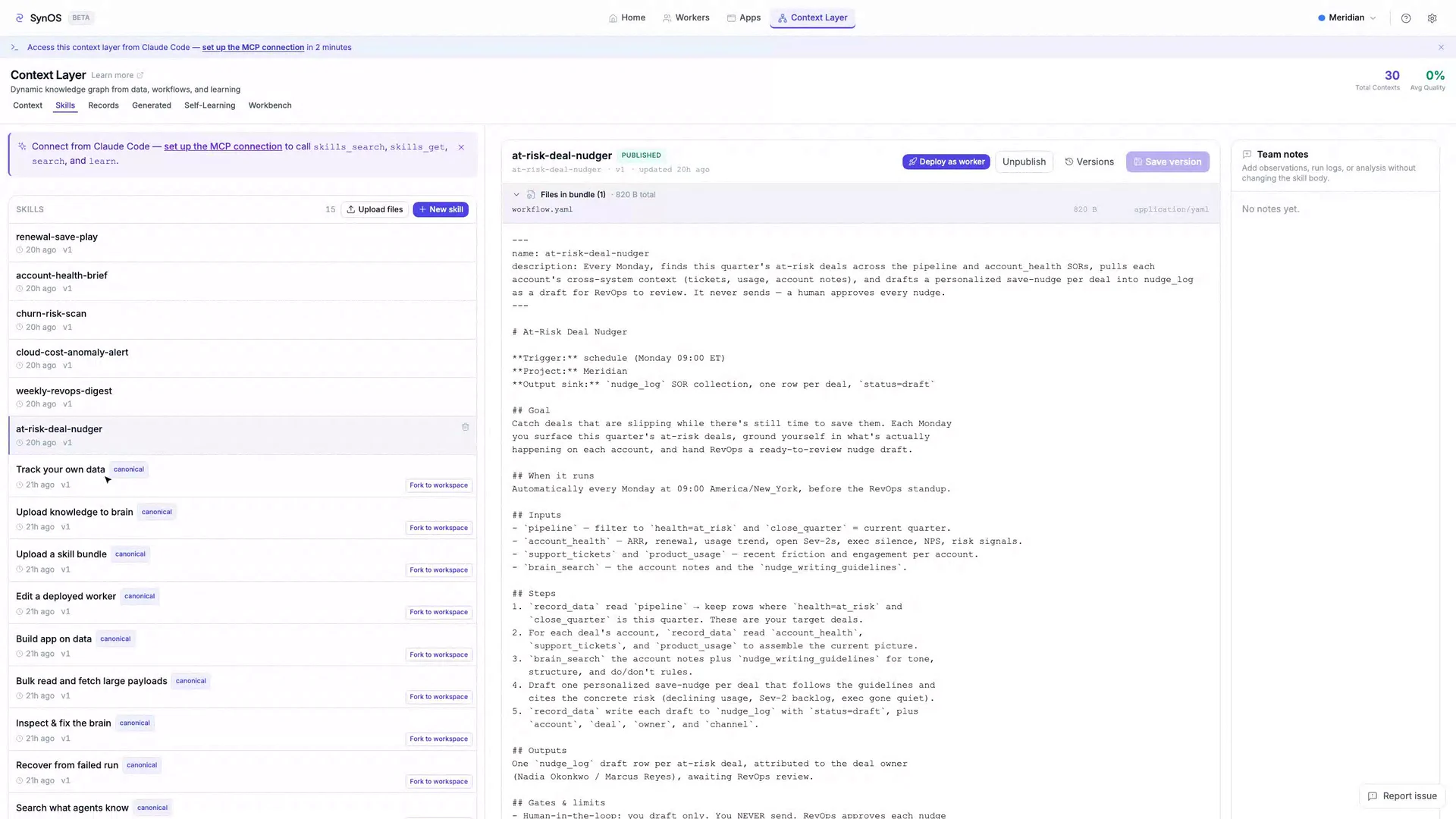
Skills compound across the team
A versioned registry — publish, fork, deploy-as-worker. The 10th teammate starts from the 9th's best work, not from scratch.
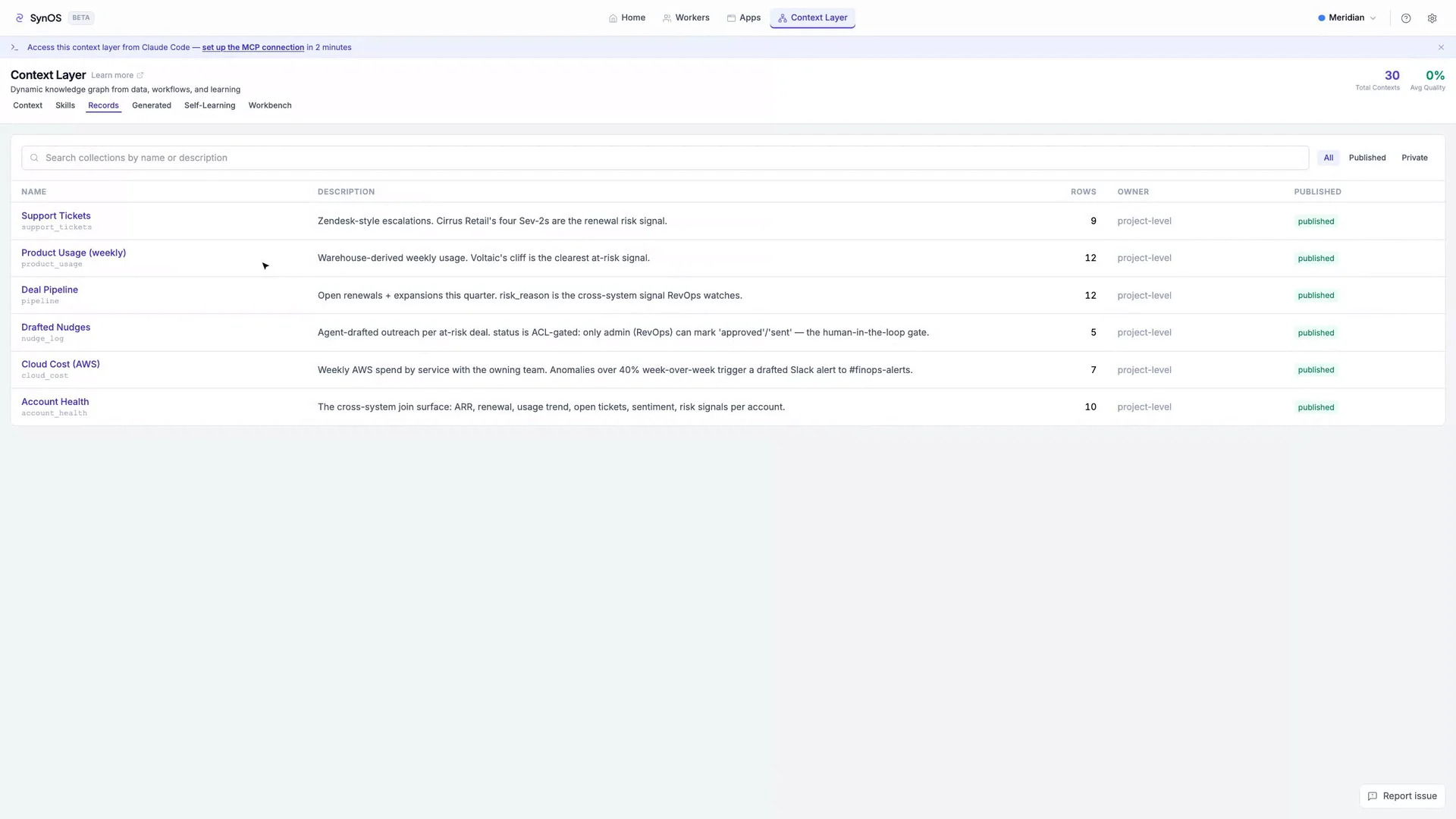
Agent-Native Storage
A system of record built for agents — typed collections your workers and apps read and write, with owners and publish state.
AI workers — scheduled, supervised, triggered
Skill-based workers doing critical knowledge work. Run manually, on a schedule, or from Slack / webhook / chat — supervised, with a kill-switch.
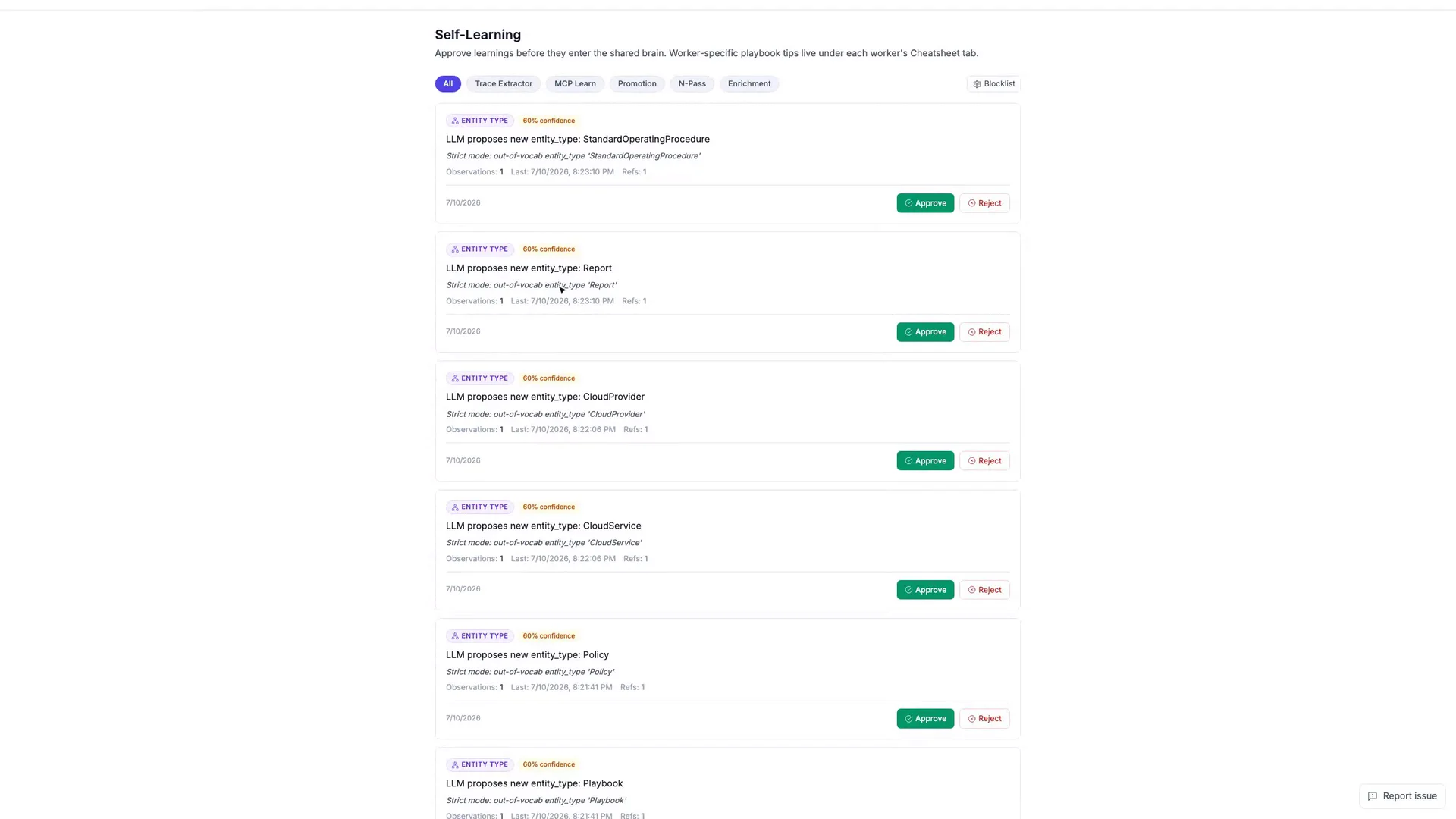
It learns from every correction
Agents propose learnings from real runs; a human approves or rejects before anything enters the shared brain. Governed compounding, not silent drift.
Describe an app → it ships and acts
A plain-English brief becomes a real app on your live data — here the At-Risk Deals view with drafted nudges and human approve-to-send.
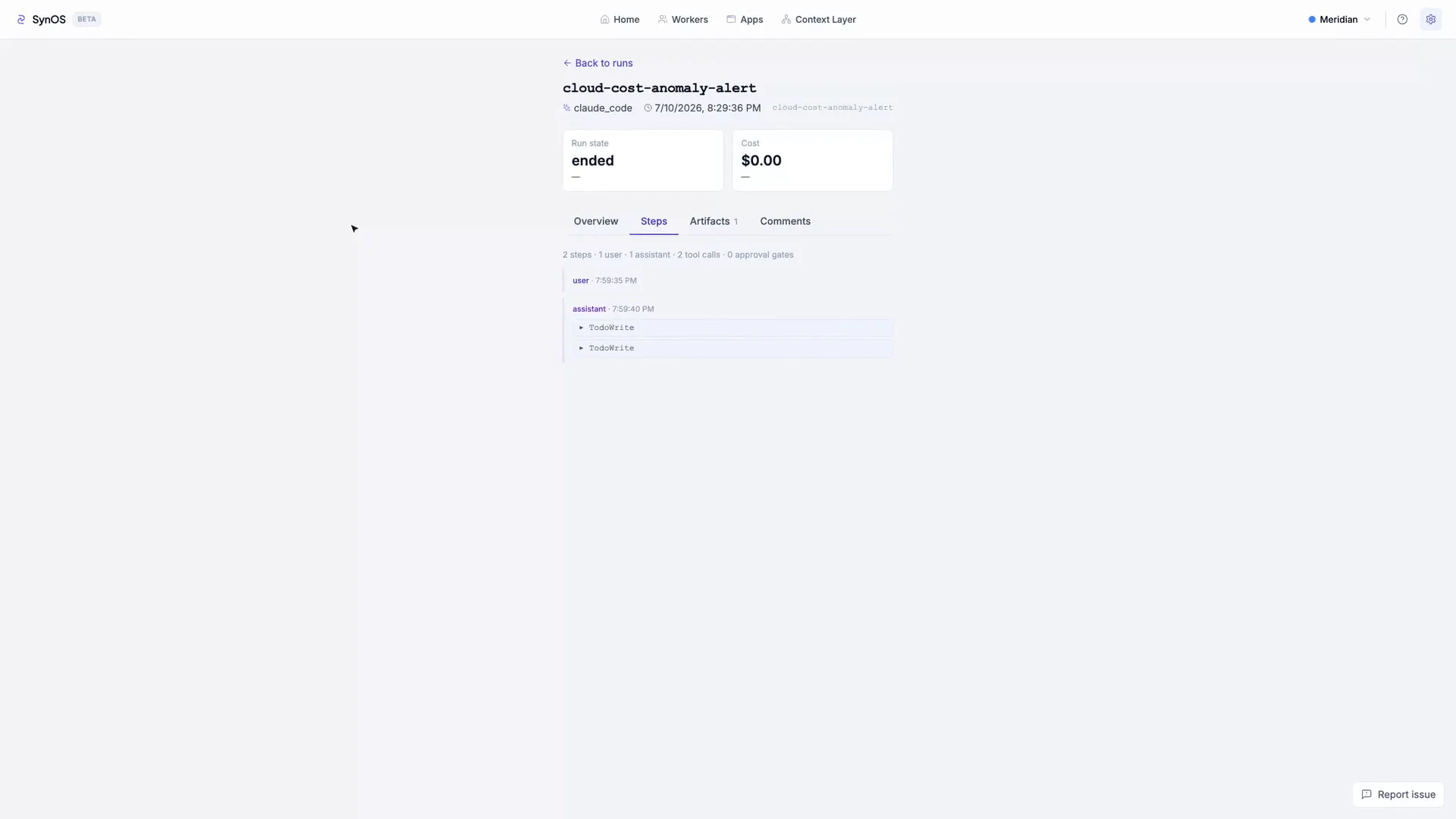
Full observability — every run traced & costed
Runs across every harness, drilled into phases, cost and tool calls — attributable and auditable.
The layer, in six pieces
One brain, wrapped in five pieces that make agents safe and useful.
Each is pre-built, so you don't rebuild it per agent. Skim here; dive into any one below.
Living Context Brain
A self-improving, entity-resolved graph over your systems — the anchor everything else hangs off.
Deep dive ↓Compounding Skills
Versioned, shareable skills — the 10th teammate starts from the 9th's best work.
Deep dive ↓Agent-Native Storage
Typed system-of-record collections built for agents to read and write.
Deep dive ↓Safe Build & Deploy
Plain-English builds, security-scanned and gated before anything ships.
Deep dive ↓Access Control & Audit
Per-skill, per-agent tool scopes and a full audit trail on every action.
Deep dive ↓Traces & Self-Learning
Every run captured; corrections promote back into the brain, human-approved.
Deep dive ↓What's Different
Why existing solutions don't solve this.
Every team we talk to has tried some combination of these categories. Here's what they found missing.
The question to ask any tool: does your agent get smarter after the 100th task? With SynOS, it does.
Bring Your Own Agent
SynOS is the operating layer, not the body.
Engineering teams spend significant time rebuilding context, skills, storage, sandboxes, access control, and trace plumbing for every new agent. SynOS ships all six pieces, pre-built. The brain at the centre comes with compounding skills, storage, safe build & deploy, access control, and traces around it. Three ways to plug in:
Two transformations, one layer
Bring your company — or your product — to life.
The same operating layer powers two moves. Both get the self-improving Context Brain, compounding skills, agent-native storage, safe build & deploy, access control, and traces — so you ship the outcome, not the plumbing.
Run your company on agents
Point the layer at your own systems of record. Non-coding teams describe apps and workers in plain English; engineers set the rails once. The brain compounds on your data and your corrections.
- Internal apps & workers on your live company brain
- Ops, RevOps, FinOps, support — one brain, every function
- Self-hosted in your VPC; raw data never leaves
Make your product agent-native
Embed agents inside the SaaS you already ship — acting on each customer's connected data. Transform an existing product, or build a new AI product on top. Own the brain, skills, and deploy; bring your own harness and models.
- In-product copilots & agents that take real actions
- A separate, isolated Context Brain per customer — multi-tenant by design
- Self-hosted in your cloud, or your customer's. No lock-in
Multi-tenant by design
Each of your customers gets their own isolated brain, storage, and permissions — no data crosses tenants. Skip rebuilding context, retrieval, governance, and traces for every agent; your second agent ships in days, and every run sharpens the brain your product runs on.
Illustrative example · synthetic, not a customer
A vertical SaaS embeds an in-product agent
Picture a clinic-management SaaS: each clinic it serves gets an isolated SynOS brain over that clinic's own records. An in-product agent drafts follow-ups and flags at-risk cases — acting only on that tenant's data, under the vendor's guardrails. The SaaS ships the AI feature; SynOS is the per-tenant brain underneath.
Under the hood
How each piece works.
The six pieces in detail — the internals, for when you want them, not the overview.
The Anchor Piece
The Living Context Brain.
A continuously curated knowledge layer every agent in your company can read from. It remembers what your team knows, what your agents have done, and how decisions get made — across every system.
What the Brain remembers
Skill
Learned procedures
How to do a recurring task. Promoted from runs the team approved.
Knowledge
Curated facts
Policies, definitions, business rules. The things your team would put in a wiki — if anyone kept the wiki current.
Entity
Resolved identities
"Customer #4892" in Salesforce = @priya in Slack = priya@acme.com in your warehouse. One graph.
Trace · the source
Raw run history
Every agent run + every human correction. The substrate the other three are distilled from.
Trace is the source. Skill, Knowledge, and Entity are what gets promoted from it.
How the Brain compounds — the Self-Learning Loop.
Every agent run and every human correction lands in Storage as a trace. Curator agents read both kinds — the agent's work and the agent↔human interaction — and surface your company's tribal knowledge: the rules, exceptions, and judgment calls nobody bothers to write down. That tribal knowledge clears a quality gate and promotes into the Context Brain. The next agent run pulls the upgraded Brain. The loop tightens with every interaction.
Continuous curation jobs re-resolve stale entities and prune dead links so the graph stays current.
Sibling Piece · Skills
How Compounding Skills spread.
A skill is a learned procedure — built once, then it belongs to the team. Skills are shared, versioned, and forked the way code is, and installable from a skill marketplace so a working agent capability spreads instead of being rebuilt per project.
Each skill carries its tool list, parameter contract, and scope declared up front — so it rides your access control wherever it runs. Promote a strong run into a skill, share it, and every agent that installs it inherits the upgrade. Skills compound the same way the Brain does.
Sibling Piece · Storage
How Agent-Native Storage works.
Today's harnesses need a shared place to track the work they do. Agent writes are multi-version, partial, contended, revisable — the patterns a typical SQL or NoSQL store wasn't built for. SynOS ships a System of Record designed for how agents actually write, revise, and reference each other's outputs.
It holds decision traces, work product, multi-agent versioning, structured artefacts, and deterministic references the next agent run can pull. Run analytics (Traces, below) sit on top of Storage; the traces here feed the Brain's compounding loop above.
Sibling Piece · Build & Deploy
How Safe Build & Deploy gates execution.
Engineering blocks "let an LLM touch prod" — for good reason. SynOS gives every agent and every app its own scanned sandbox. Build-time scanning catches unsafe imports and secrets before anything runs; egress is policy-controlled per sandbox; per-run identity tokens scope what the running code can touch.
| Mode | What Happens | When to Use |
|---|---|---|
| Supervised | Plans actions, doesn't execute. See what it would do before anything happens. | First days — validate accuracy and judgment |
| Shadow | Reads execute. Writes are logged but don't fire. Build confidence without risk. | Building confidence — verify write behavior is correct |
| Approved | Writes fire only on explicit human approval. Per-action review queue. | Production-grade tasks where mistakes are costly |
| Autonomous | Full execution with per-tool permissions and audit trail. You review exceptions. | When accuracy is proven — trust earned, not assumed |
Sibling Piece · Access
How Access Control & Audit scope skills.
Per-skill, per-agent, per-team scopes. Revocable. Auditable. Templates, not tickets — your AI team defines a scope once and it applies to every agent that installs the skill.
A skill ships with its tool list, its parameter contract, and its role check declared up front. Install once. Share across the team. Permissions ride with the skill, not the user who happens to run it.
Sibling Piece · Traces
What Traces & the Self-Learning Loop capture.
Every run, every tool call. Cost, latency, success and failure, hallucination signal, who-ran-what. Cached and budgeted — predictable cost per decision at scale.
Three consumers: your AI team reads them for analytics; the Brain reads them for the Self-Learning Loop; Permissions reads them to adjust scopes as patterns shift.
Retrieval
Two ways the Brain serves agents.
Some questions have a known shape — pull the right slice and hand it over. Others need a walk through the graph. The Brain ships both.
Pack assembly.
Single call. For questions with a known shape — predictable cost, predictable latency.
Sub-agent walk.
For open-ended questions where the right slice isn't known up front. A retrieval sub-agent plans, calls, observes, and refines as it traverses the graph.
Both paths hand the calling agent the same context envelope — authority-ranked, freshness-aware, policy-redacted.
Lifecycle
Connect. Profile. Link. Permission. Execute. Trace. Compound.
Only context is extracted — not raw data. Your systems of record remain untouched. Each step exercises a piece of the layer.
Connect
Plug in your data sources. No migration.
Profile
Auto-extract schema, stats, business semantics.
Link
Discover cross-system relationships. Resolve entities.
Permission
Scope tools per skill, per agent, per team.
Execute
Agents run in scanned sandboxes. Reads and writes audited.
Trace
Every run captured — cost, outcome, signal.
Compound
Traces and corrections promote into the Brain. Next run pulls more.
Tools, connectors & triggers
Connect your systems, act on them, trigger however you need.
One capability surface. Every action is permission-scoped per tool and per agent, and every action is audited.
Connect
Standard methods — OAuth, API keys, connection strings. Any system with an API becomes a connector.
Documents
Google Docs, Notion, Confluence
Data Stores
BigQuery, Snowflake, Redshift, PostgreSQL, MySQL, MongoDB, Google Sheets
Project Management
Linear, Jira, Asana
Communication
Slack, Microsoft Teams, Google Chat, Email (Gmail, Outlook)
CRM
Salesforce, HubSpot
Cloud Infrastructure
AWS (Cost Explorer, CloudWatch), GCP (Billing, Monitoring), Azure
Billing & Finance
Stripe, Chargebee, NetSuite
Code & Deploys
GitHub, GitLab
APIs & Internal Systems
REST API endpoints, webhooks — any system with an API becomes a connector
Need a connector we don't have? New connectors ship fast based on design partner needs.
Act
Structured, permission-controlled operations — allow reads on one system while denying writes on another.
Read
Query your CRM, data warehouse, databases, and documents.
Write
Update spreadsheets, create CRM records, insert database rows, send messages.
Communicate
Send Slack messages, Google Chat, email. Route alerts to the right people.
Research
Web search, web scraping, API calls. Bring in external context on demand.
Custom Tools — extend with your own logic
Save tested queries as reusable tools with template variables. No code deployment — define once, assign to any agent. Your saved, validated query runs deterministically. Scoped write tools restrict which objects a tool can modify.
Trigger
All triggers feed the same execution engine with the same graduated-trust controls.
Manual
One-click from the UI
Scheduled
Cron-based with timezone
Webhook
External system triggers via POST
Chat
Slack, Google Chat, or built-in UI
Voice
Phone calls, multi-language
Enterprise & self-hosted
Enterprise-grade. Self-hosted by default.
Self-Hosted
Single VM in your cloud. Your data stays on your infrastructure. Zero egress.
Managed by SynOS
Dedicated instance provisioned and managed by us. Same architecture, zero ops burden.
SaaS
Hosted multi-tenant for teams that prefer fully managed infrastructure.
All deployment modes use identical architecture — zero code changes to switch between them.
SynOS gives them your company's Agent-Native Operating Layer.
See it with your data.
Walk through the architecture with your actual stack, your actual connectors, and your actual workflows. No slides.
Or read the thesis → on Substack.